
MOTIVAIT
  • Home
  • Solutions
  • Resources
  • About us
  • Contact us
  • Menu
  • Twitter
  • Linkedin
  • Instagram
Engagement

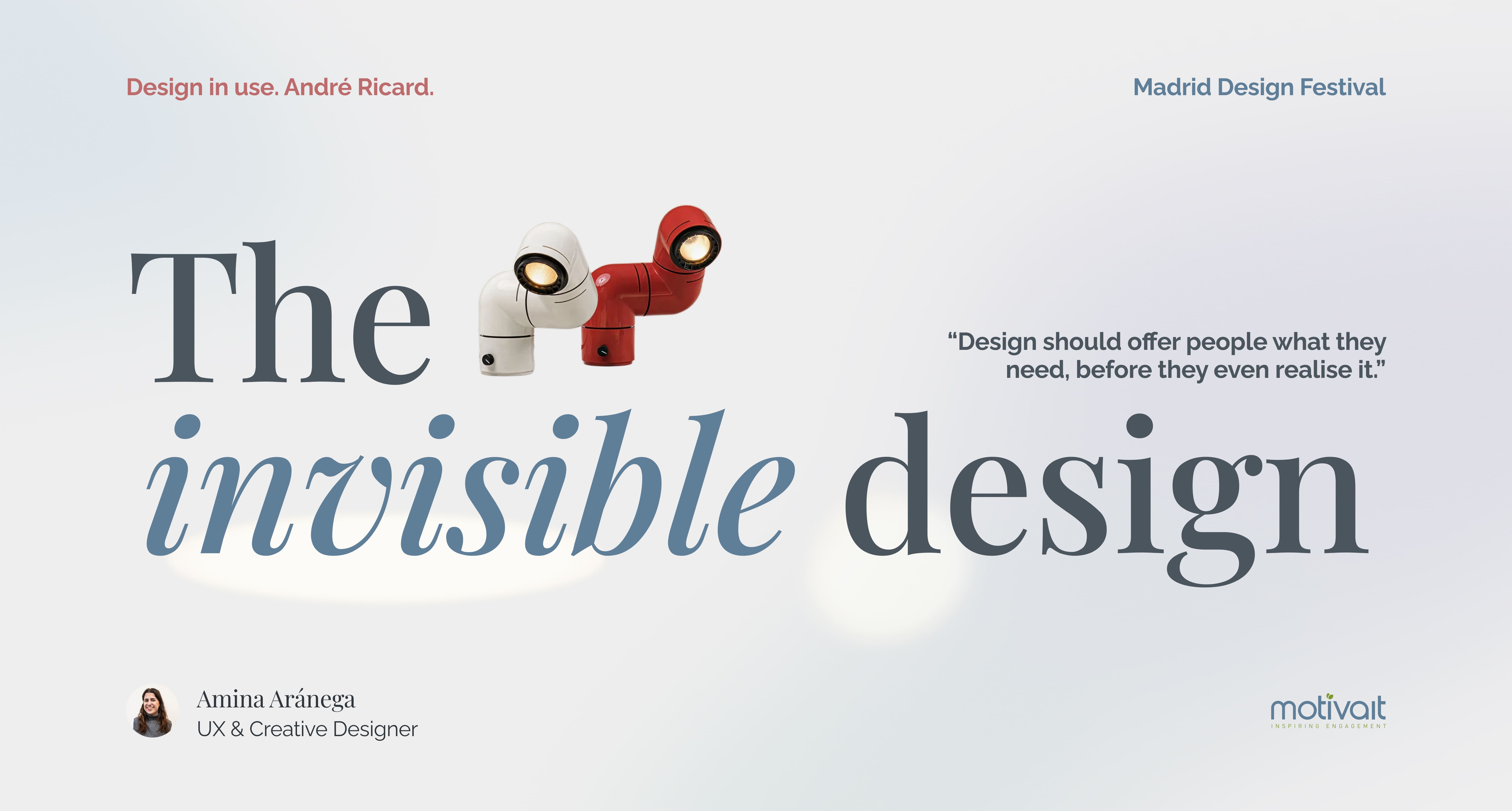
The Invisible Design

As part of the ninth edition of the Madrid Design Festival, I had the chance to attend “Design in use”, an exhibition created by André Ricard, one of the true pioneers of industrial design in Spain. Ricard has transformed the way products are designed by placing the user’s needs at the heart of the problem, always asking: “How can I make their life a little easier?”

The exhibition itself reflects that philosophy. There are no display stands or museum showcases. Instead, you move through a series of familiar spaces, a dining room, a kitchen, a studio, where each object sits exactly where you’d expect to find it, revealing how every design decision was made with purpose.

Ricard has spent decades designing everyday objects: the Clipper lighter, cleaning products, lamps…Things we all recognise, yet never stop to question. We simply know they work, and that they make life that bit simpler. When something works as it should, we stop noticing the object itself; we focus entirely on what we’re doing. The design fades into the background, and all that remains is the experience, one that, if it feels right, will bring people back.

As a UX designer, I found this deeply fascinating. Ricard was practising user-centred thinking long before anyone coined terms like engagement or user-first. The vocabulary didn’t exist yet, but the understanding did. He already knew what actually mattered.

The same principle plays out in digital products every day. When an employee opens their work platform because they genuinely want to. When a customer returns because a brand adds value to their life. When a student finishes a module without anyone nudging them along. That’s good design, not because it’s clever or visible, but because it adapts quietly into people’s routines and makes them work better. Ricard calls it design in use. We now call it user-centered design. Different words, same truth.

Great design ideas travel across disciplines and across decades. And real loyalty, whether to a physical product or a digital one, is the kind that goes unnoticed. The kind that simply becomes part of people’s lives, making them just a little bit better.

 

22/04/2026/by Amina Aranega
https://www.motivait.net/wp-content/uploads/2026/04/InvisibleDesign-cover-1.jpg 3999 6000 Amina Aranega https://www.motivait.net/wp-content/uploads/2022/10/motivait-logo-web-300x113-1.png Amina Aranega2026-04-22 09:20:322026-04-22 09:20:39The Invisible Design
Engagement

It’s Time To Focus on the Experience

Engagement hasn’t declined so much as it has stalled, and that matters more than it might initially appear. Stagnation is easy to overlook because it rarely announces itself, instead, it shows up gradually in the background, through slowing momentum, weaker connection and a growing sense that despite repeated effort, little meaningfully changes.

The Engage for Success 2025 report reflects this reality. Engagement levels remain broadly flat, inclusion gaps continue to widen and despite sustained investment in listening approaches, many organisations still struggle to convert feedback into visible and meaningful action. Most employees are not asking for more mechanisms to share their views, they are looking for evidence that their voice leads to change.

At the centre of the report are four established drivers of engagement: a clear strategic narrative that gives people direction and purpose, managers who lead with consistency and humanity, a genuine employee voice that influences decisions rather than merely informing them, and organisations that deliver on what they say they will do. These are not new ideas and there is little disagreement about their importance. The challenge lies in consistent execution rather than conceptual understanding.

Where organisations tend to fall short is in sustaining the principles over time. Feedback is often collected with good intent, analysed carefully and  shared across the organisation, yet the loop frequently ends without employees seeing what has changed as a result. Over time, this creates a subtle but significant erosion of trust, as people begin to question whether speaking up makes any real difference.

This is where belonging becomes particularly important. The report reinforces what many in employee experience already observe: engagement is increasingly shaped by whether people feel they truly belong within their team and organisation. When belonging is strong, individuals are more likely to contribute energy, commitment and ideas. When it is weak, even well-designed initiatives struggle to create meaningful impact.

It is therefore useful to understand engagement not as an intervention or programme, but as a response to the everyday experience of work. It is formed through the accumulation of consistent, ordinary moments: whether people feel trusted to do their work, whether managers provide steady and supportive leadership, whether recognition feels genuine and timely, whether individuals can clearly connect their work to organisational purpose, and whether they feel able to speak up, develop and progress.

From this perspective, engagement is not a standalone goal but an outcome of how work is experienced in practice.

For those working in employee experience, this shifts the focus away from engagement as a metric to be improved and towards the design of work itself. The key question becomes whether the conditions of work consistently enable people to perform at their best. That includes whether managers are properly equipped to lead, whether feedback loops are closed transparently, whether hybrid and dispersed teams remain connected and whether employees continue to feel a sense of pride and meaning in what they do.

The central challenge highlighted by the data is not a lack of knowledge or intent, but a lack of consistency in execution. Until organisations address that gap, engagement will remain something they measure, rather than something people reliably experience.

21/04/2026/by Bill Paris
https://www.motivait.net/wp-content/uploads/2026/04/Its Time-We-Focus-on the Experience-Web-2.jpg 1333 2160 Bill Paris https://www.motivait.net/wp-content/uploads/2022/10/motivait-logo-web-300x113-1.png Bill Paris2026-04-21 10:11:542026-04-21 11:49:37It’s Time To Focus on the Experience
Engagement

Loyalty in Uncertain Times: Why Customer Engagement Matters More Than Ever

The UK high street and hospitality sectors are once again facing a period of economic uncertainty.

Several established brands and household names are closing stores or disappearing from the high street entirely. Brands such as River Island, BrewDog, QUIZ Clothing, GAME, Revolution and TGI Friday’s have all made headlines in recent months, and these stories are becoming increasingly common.

For employees, communities and customers, these closures are about more than business performance. They represent jobs, memories and long-standing institutions that have shaped the British high street for decades.

From a personal perspective, these are brands I’ve connected with as a customer, partnered with professionally, or even worked for (if we include a short period at GAME during my university days.)

While it may be tempting to point to a single cause, the reality is more complex. Businesses are navigating a combination of economic pressure, structural industry shifts and rapidly evolving consumer expectations.

So how can brands respond and position themselves for long-term success?


A Challenging Economic Landscape

Consumer-facing industries are currently operating in one of the most challenging environments in recent years.

Operational, staffing and rental costs continue to rise. At the same time, global uncertainty, including geopolitical tensions, tariffs and supply chain disruption, is driving volatility in energy prices and logistics.

Meanwhile, many households are still feeling the effects of the cost-of-living crisis. As disposable income tightens, consumers are becoming more intentional in their purchasing decisions. They are comparing options more carefully, prioritising value, and increasingly choosing brands they trust. More importantly, this doesn’t mean consumers stop spending, it means spending becomes more deliberate.

So how does this effect marketers in particular?

Reduced Marketing Budgets

As costs increase and revenues come under pressure, marketing budgets are often one of the first areas to be reduced.

Marketers are now expected to deliver stronger results with fewer resources, while every investment decision faces increased scrutiny.

As one senior marketer recently told me: “Every pound is now a prisoner.”

Changing Customer Expectations

Consumers still want to shop, dine and enjoy experiences, but they are becoming more selective.

Today’s customers prioritise brands that feel reliable, trustworthy and worth the investment.

For marketers, this means that simply increasing promotions or discounting is no longer enough. Customers are not just looking for lower prices, they are looking for confidence in their choices.

Rising Cost of Customer Acquisition

The cost of acquiring new customers continues to increase.

Paid search, social media advertising and digital channels are more competitive than ever. At the same time, privacy regulations, cookie restrictions and evolving algorithms are making targeting and attribution more complex.

As a result, many organisations are seeing steadily rising customer acquisition costs (CAC).

In this environment, growth strategies that rely heavily on acquisition are becoming less sustainable. Instead, brands must focus on maximising the value of existing customers.

—

Why Customer Loyalty and Engagement Matter More Than Ever

This is where customer loyalty programmes and engagement strategies become critical.

While loyalty initiatives are not a guaranteed solution to economic challenges, they can play a significant role in strengthening relationships between brands and their customers.

Customers who feel recognised, valued and understood behave differently. They are more likely to:

  • Make repeat purchases
  • Recommend the brand
  • Stay loyal even during price increases or economic downturns

At its core, customer loyalty is not just about points, rewards or discounts. It is about building emotional connection, trust and long-term relationships.

During periods of economic uncertainty, these factors become a powerful competitive advantage.

While customer acquisition remains important, customer retention and engagement provide a more stable and predictable revenue foundation.

—

How Brands Can Strengthen Customer Engagement Today

While businesses cannot control external economic conditions, they can control how they engage with their customers.

Here are four key focus areas:

  1. Build Stronger Customer Relationships: Deepening relationships with existing customers should be a top priority. This includes, delivering more relevant and personalised communication, recognising and rewarding loyal customers and creating meaningful, non-transactional engagement.
  2. Clearly Communicate Value: In uncertain times, clarity is essential. Customers respond to simple, transparent value propositions. Loyalty programmes and rewards should be easy to understand and genuinely beneficial.
  3. Leverage First-Party Customer Data: First-party data is becoming increasingly valuable in a privacy-first world. Brands that understand their most valuable customers, and what drives their behaviour, can allocate marketing spend more effectively and deliver more personalised experiences.
  4. Invest in Employee Engagement: Employee experience has a direct impact on customer experience. Empowered, engaged employees are more likely to deliver the level of service that builds trust and long-term loyalty.

While brands cannot control economic uncertainty, they can control how they invest in relationships. For many organisations, this means placing greater emphasis on customer engagement, loyalty and retention strategies. When consumers are spending more carefully, trust, recognition and emotional connection often determine where they choose to spend.

The brands that invest in these relationships today will be the ones best positioned to navigate the uncertainty of tomorrow.

 —

We’re here to help 

Every brand is different. The most effective customer loyalty and engagement strategies are never one-size-fits-all,  they should reflect your brand’s goals, values and audience expectations.

At Motivait, we specialise in delivering complex, omnichannel and multinational loyalty and engagement solutions.

If you’re exploring how to strengthen your customer engagement strategy, we’d love to start a conversation.

14/04/2026/by Matt Charles
https://www.motivait.net/wp-content/uploads/2026/04/Fidelización-en-tiempos-de-incertidumbre-Web-1.jpg 1333 2160 Matt Charles https://www.motivait.net/wp-content/uploads/2022/10/motivait-logo-web-300x113-1.png Matt Charles2026-04-14 15:41:512026-04-20 15:16:29Loyalty in Uncertain Times: Why Customer Engagement Matters More Than Ever
Customer Engagement, Employee Engagement, Employee Experience, Engagement

Designing the I love this… experience

Read more
01/04/2026/by Patricia Wiggett
https://www.motivait.net/wp-content/uploads/2026/03/I-Love-this-Eperience.jpg 1333 2000 Patricia Wiggett https://www.motivait.net/wp-content/uploads/2022/10/motivait-logo-web-300x113-1.png Patricia Wiggett2026-04-01 12:17:422026-04-15 11:56:24Designing the I love this… experience

Categories

  • Alumni
  • Behavioural Design
  • Case Study
  • Citizens
  • Customer
  • Customer Engagement
  • Employee Engagement
  • Employee Experience
  • Employees
  • Engagement
  • Gamification
  • Learning
  • Learning & Development
  • Loyalty
  • Membership
  • MOTIVAIT
  • Motivation
  • Partners
  • Podcast
  • Press releases
  • Team building
  • Whitepapers

Search

Motivait


UK Offices

Newcastle
The Core 5.22
Newcastle Helix
Bath Lane
Newcastle upon Tyne
NE4 5TF
+44 191 495 7340

Spain Offices

Madrid
Av. de Bruselas, 13
Ed. América
28108 Alcobendas
+34 91 425 86 57

Solutions
About
Careers

Resources
Blog
Contact

Cookie Policy | Legal Information | Quality and Security Policy | Motivait® is a registered trademark of Motivait Holdings Ltd.
  • Twitter
  • Linkedin
  • Instagram
Scroll to top
Manage Cookie Consent
We use cookies to ensure that we give you the best experience in our website
Functional Always active
The technical storage or access is strictly necessary for the legitimate purpose of enabling the use of a specific service explicitly requested by the subscriber or user, or for the sole purpose of carrying out the transmission of a communication over an electronic communications network.
Preferences
The technical storage or access is necessary for the legitimate purpose of storing preferences that are not requested by the subscriber or user.
Statistics
The technical storage or access that is used exclusively for statistical purposes. The technical storage or access that is used exclusively for anonymous statistical purposes. Without a subpoena, voluntary compliance on the part of your Internet Service Provider, or additional records from a third party, information stored or retrieved for this purpose alone cannot usually be used to identify you.
Marketing
The technical storage or access is required to create user profiles to send advertising, or to track the user on a website or across several websites for similar marketing purposes.
Manage options Manage services Manage {vendor_count} vendors Read more about these purposes
View preferences
{title} {title} {title}